Eyes on the
Sky
The Kind of Attention Brands Can’t Manufacture
By: Sergio Moises, Growth & Innovation Manager
I was wrapping up my workday when a coworker asked if I was planning to watch the Artemis II launch.
I had completely forgotten about it, but I pulled it up on my phone and let it play in the background while I worked.
Somewhere between “background noise” and liftoff, I found myself fully locked in. By the time it was over, I couldn’t stop thinking about everything behind it. The coordination, the precision, the sheer scale of what it takes to pull something like that off.
And of course, the strategy behind how it was shared with the world.
But there’s something kind of strange about watching a rocket launch in 2026.
Not the launch itself. That part still feels the same. Loud, powerful, impossible to fully process. It’s everything around it that’s different.
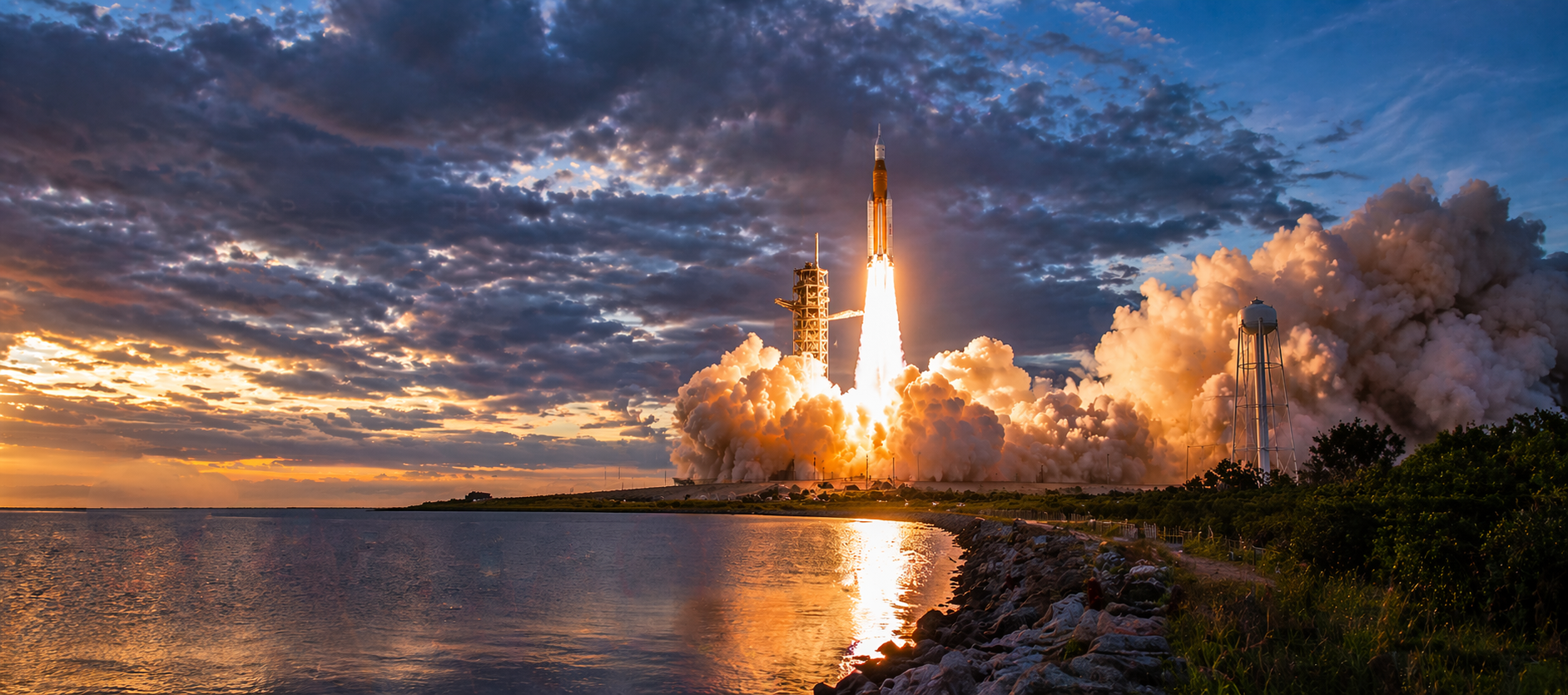
Phones out. Livestreams open. Group chats lighting up. People watching from rooftops, beaches, office windows. Some in person, most not. But all tuned in.
Artemis II isn’t just another launch. It’s NASA’s first crewed mission around the Moon in over 50 years. That alone makes it historic.
But what’s more interesting is how people are experiencing it.
Because this isn’t 1968.
Back then, the world gathered around televisions. A shared moment, but a centralized one. Now, attention is everywhere. Fragmented across platforms, perspectives, and screens.
And somehow, launches like Artemis II still cut through.
That’s the part worth paying attention to.
Space has always had this effect. It pulls people in. It gives them something bigger than whatever’s happening in their day-to-day. For a few minutes, everyone is looking up. Or at least, looking at something that represents up.
But today, that attention doesn’t just sit in one place. It spreads.
A single launch becomes thousands of moments. A TikTok from Cocoa Beach. A YouTube livestream with live chat flying by. A tweet that turns into a thread. A photo that gets reposted a hundred times before the rocket even clears the tower.
It’s not just an event anymore. It’s content.
And not in the way brands usually think about content.
No one’s watching Artemis II because it’s optimized for engagement. No one’s there for a hook or a call-to-action. They’re there because it means something. Because it feels important. Because it’s rare that we all get to witness something that pushes the edge of what’s possible.
That’s what creates the attention.
From a brand perspective, that’s where this gets interesting.
We spend a lot of time trying to earn attention. Tweaking headlines, chasing trends, testing formats. And all of that matters. But moments like this are a reminder that attention isn’t just captured. It’s given.
People choose to pay attention when something feels bigger than the content itself.
That’s why space works so well.
It’s not just rockets. It’s progress. It’s curiosity. It’s the idea that we’re still exploring, still figuring things out. There’s an optimism baked into it that’s hard to replicate anywhere else.
And audiences respond to that.
We’ve seen it in the data. People are more likely to engage with, travel to, and buy from brands that align with space. Not because it’s trendy, but because it represents something aspirational. Something forward-looking.
Artemis II is a perfect example of that in real time.
You don’t need to be a space expert to care about it. You just need to feel like it matters.
That’s the opportunity for brands.
Not to insert themselves into the moment in a forced way. Not every brand needs a “launch day post.” But to understand why people are paying attention in the first place.
It’s about scale. Meaning. Shared experience.
If you can tap into even a fraction of that, it sticks.
Especially here in Florida, where launches aren’t just headlines, they’re part of the rhythm. Something you can see, feel, and plan your day around. It’s a built-in connection point between a global moment and a local experience.
That’s not something most places have.
And it’s not something most industries can replicate.
But the principle still applies.
People are looking for moments that feel bigger than the scroll. Artemis II just happens to deliver one of the clearest versions of that.
And for a few minutes, at least, everyone’s paying attention.
And that attention doesn’t just disappear. It translates.
Artemis II is expected to bring in around $160 million in economic impact, from tourism to local businesses to the broader space ecosystem. Hotels fill up. Restaurants get busier. Beaches turn into viewing spots. What starts as a moment in the sky becomes something very real on the ground.
That’s the power of attraction.
At &Barr, that’s what we focus on. Not just getting in front of people, but giving them a reason to lean in. To care. To show up, whether that’s physically or digitally.
Because the best marketing doesn’t interrupt attention. It earns it.
Space does that naturally. It creates moments people want to be part of. Our job is to help brands tap into that same feeling. To build strategies that don’t just reach audiences, but actually draw them in.
Artemis II is a reminder that when something truly matters, people will stop what they’re doing and pay attention.
The opportunity for brands is to give them a reason to keep looking.