Remembering
the Em Dash
An Appreciation for the Dash That Did Nothing Wrong
By: Morgan Lyons, Account Executive
“The Heart wants what it wants — or else it does not care”
Emily Dickinson
“It was the best of times, it was the worst of times—”
Charles Dickens
“The difference between the almost right word and the right word is really a large matter—it is the difference between the lightning-bug and the lightning.”
Mark Twain
Last week, while reviewing copy for the sixth time, I deleted an em dash.
Not because it was wrong. Not because it was overused. Not because AP Style suddenly changed its mind.
I deleted it because I was afraid someone would think ChatGPT wrote it.
And just like that, another innocent em dash became collateral damage.
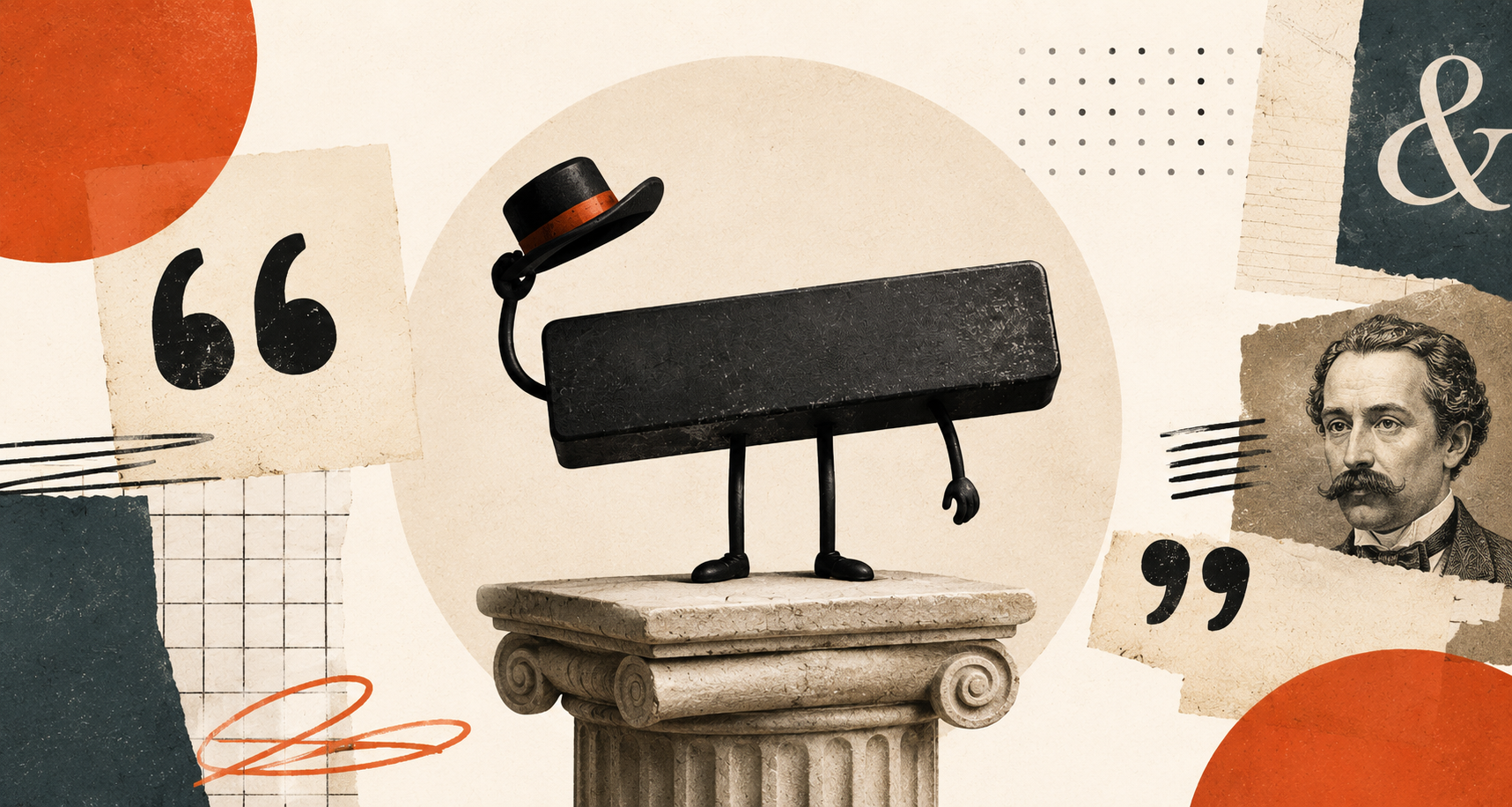
For those unfamiliar with the victim, the em dash was once a thriving member of the writing community. It connected thoughts. It created drama. It let writers change directions mid-sentence without committing to a semicolon. It was versatile, elegant, and slightly chaotic, like the Account Executive of punctuation 😉
For years, the em dash lived peacefully among us. It appeared in novels, magazines, emails, blogs and passive-aggressive Teams messages. Nobody questioned its intentions.
Then AI happened.
Suddenly, every em dash became suspicious.
People started whispering.
“Did a robot write this?”
“That seems like a lot of em dashes.”
“No human would use punctuation this thoughtfully.”
The accusations came fast.
Meanwhile, the em dash sat quietly in Times New Roman, wondering what it had done wrong.
Let’s be clear: the em dash didn’t ask to become AI’s favorite punctuation mark. It was simply in the wrong keyboard shortcut at the wrong time.
Now, writers everywhere are abandoning it. Marketing teams are replacing it with commas. Copywriters are forcing awkward sentence structures. LinkedIn thought leaders are using line breaks where punctuation once stood.
The em dash didn’t deserve this.
If we’re being honest, it was one of the last pieces of punctuation willing to do real work. The semicolon only shows up for special occasions. Parentheses constantly distract from the main point. The ellipsis is somehow always in the middle of an emotional crisis.
The em dash showed up every day and connected ideas without asking for recognition.
Maybe one day public opinion will change. Maybe we’ll stop treating every em dash like forensic evidence. Maybe future generations will once again type one without fear of being accused of collaborating with artificial intelligence.
Until then, we gather here to remember a punctuation mark gone too soon.
It is survived by its cousins, the en dash and the hyphen, who would like everyone to stop confusing them.
In lieu of flowers, the family asks that you use one em dash this week.
Just to let it know it’s not alone.
After all, if the em dash was good enough for Dickinson, Dickens, and Twain, it probably deserves a little more benefit of the doubt than a plagiarism detector’s side-eye.
Author’s Note: This blog was written by a human. The em dashes insisted on representing themselves.